1Before you start
On 2026-10-22 only one exchange traded DIVI in any volume: Nonkyc, with the pair DIVI/USDT. StakeCube listed four DIVI pairs with no trades for over a week, XeggeX had no DIVI market at all, and nothing else listed it. Where to buy DIVI has the full list and the dates. So this page uses Nonkyc as the worked example, because it is the only example, not because it is the best choice for you.
Four things to know about that exchange before you give it an email address, all from its public help pages and fee page on 2026-10-22:
- You must be 18 or older to register, and two-factor authentication is mandatory: for logging in, for changing settings and for adding a withdrawal address.
- It is crypto-only. You cannot pay by card or bank transfer. You bring a coin you already own, usually the stablecoin USDT, and trade it for DIVI. Step 3 covers where USDT comes from.
- The trading fee is 0.2% of each trade at the starting tier, falling with volume. The withdrawal fee is pegged at about one dollar in whatever coin you withdraw.
- Support is by ticket only, answered within 12 hours, and the team says it never sends direct messages. Anyone messaging you first is not them.
The exchange does not ask for identity documents at the volumes a DIVI buyer deals in. That does not change your own tax and reporting duties, which depend on where you live, not on where the exchange is. If your country restricts exchanges that skip identity checks, that is your problem to resolve, not the exchange's. We cannot tell you the rules for your country.
2Read the market page without an account
The market page nonkyc.io/market/DIVI_USDT is public. Open it before you sign up and read three things off it:
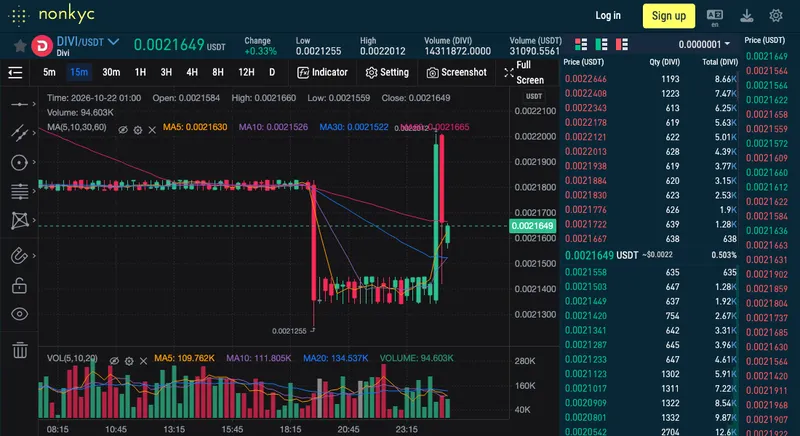
- The last price and the spread. The large number is the last trade. In the order book, the lowest red row is the cheapest seller and the highest green row is the best buyer. At 01:08 UTC these were 0.0021667 and 0.0021558 USDT, a gap of half a percent. A wide gap means a thin market.
- 24-hour volume. The header showed 14,311,872 DIVI traded, worth 31,090 USDT. That is the whole day's trading for the whole coin. Any single order of a few hundred dollars is a noticeable part of it.
- The order book depth. Scroll the red rows. Each row is an amount for sale at a price; buy more than the first row holds and you pay the next row's price for the rest. The numbers in step 5 come from reading this book all the way down.
3Get USDT onto the exchange
USDT is a stablecoin worth one US dollar, and DIVI is priced in it. Because the exchange takes no card or bank payments, you need USDT first, either from a wallet you already have or from an exchange in your country that does take bank transfers and does identity checks. You then send the USDT to your deposit address on Nonkyc.
USDT exists on many networks and the exchange accepts it on these, each with its own deposit address. The sending side must use the same network as the address you copy, or the money is lost. On 2026-10-22 the withdrawal fees per network, which show what each network costs to use, were:
| Network | Exchange label | Fee (USDT) |
|---|---|---|
| Tron | USDT-TRC20 | 5.0 |
| Ethereum | USDT-ERC20 | 2.5 |
| BNB Smart Chain | USDT-BEP20 | 1.00 |
| Polygon | USDT-PLG20 | 1.00 |
| Arbitrum One | USDT-ARB20 | 1.00 |
| Solana | USDT-SOL | 1.00 |
| Avalanche C-Chain, Optimism, opBNB | USDT-AVAXC20, USDT-OP20, USDT-OPBNB20 | 1.00 |
Minimum deposit is 1 USDT on every network. Pick the network your sending wallet or exchange supports with the lowest fee on their side, then select exactly that network when you ask Nonkyc for a deposit address. Send a small test amount first; a lost test costs a dollar, a lost deposit costs the deposit.
4Limit order or market order
Once the USDT shows in your balance, the buy form under the chart offers two kinds of order:
- Limit order: you name a price and an amount. The order sits in the green side of the book until a seller accepts it. You might wait minutes or days, but you never pay more than your price. On a thin market this is the order to use.
- Market order: you name an amount of USDT and the exchange buys from the red rows, cheapest first, until your money is spent. It fills instantly, at whatever prices the book holds. On a thin market this is how people overpay by a third without noticing.
A limit order placed at the best bid (the top green row) or a touch above it fills when the next seller comes along. Placing it at the best ask (the lowest red row) usually fills at once and is still safer than a market order, because it cannot climb past that price.
Order forms default to "market" on many exchanges. Check the tab says Limit and that the price box holds a number you typed, before you press Buy. The next step shows what the difference is worth.
5What a purchase really costs
We took the public order book at 01:08 UTC on 2026-10-22 (100 sell rows, 1.95 million DIVI on offer in total, worth 7,567 USDT) and worked out what a market order would have paid at four sizes. "Above best ask" is how much more per coin you pay on average than the cheapest seller was asking:
| Market order | DIVI received | Average price | Above best ask |
|---|---|---|---|
| 20 USDT | 9,033 | 0.002214 | +2.2% |
| 100 USDT | 42,974 | 0.002327 | +7.4% |
| 500 USDT | 197,512 | 0.002531 | +16.8% |
| 2,000 USDT | 678,186 | 0.002949 | +36.1% |
The same 500 USDT as a limit order at the best ask, 0.0021667, would buy 230,766 DIVI if the market came to meet it, 33,000 more coins than the market order. The highest sell order in the book that night was 0.0056636, two and a half times the last price; a large enough market order reaches it.
On top of the price comes the 0.2% trading fee, taken from the coins you receive: 100 USDT of DIVI costs 0.20 USDT in fee, 500 USDT costs 1.00 USDT. The fee is small; the depth is what costs money.
The exchange's fee page says every withdrawal costs about one US dollar in the coin withdrawn. For DIVI on 2026-10-22 that was 463 DIVI, and it drifts as the price moves (it was 459 DIVI a few hours earlier). A 9,000 DIVI purchase loses 5% of itself to that fee on the way out, a 200,000 DIVI purchase loses 0.2%. Buy in one go rather than in many small lots.
6After the buy: get the coins out
When the order fills, the DIVI shows in your exchange balance. That balance is a promise from the exchange, not coins in a wallet you control; they cannot stake for you there either. Move them out:
- Have a Divi wallet ready with a receive address. If you do not have one yet, Create a wallet and back it up first. A mainnet address is 34 characters and starts with D.
- Open the exchange's withdraw page for DIVI. On 2026-10-22 it showed network Divi Main Chain, fee 463 DIVI, and the note "Wallet is re-syncing." Deposits and withdrawals were both marked active despite the note; if yours does not arrive within an hour, that note is the first thing to check again.
- Paste your address, add it as a withdrawal address (this is one of the steps that demands the two-factor code), and withdraw. Keep at least the fee plus something in reserve on the exchange side, or the request fails for lack of balance.
- Watch for the transaction on the explorer. A Divi block comes every minute. Your wallet shows the coins as unconfirmed first, then spendable.
The full procedure, with a transaction we actually made on testnet, is in Withdraw to your wallet. Going the other way, the exchange needs 600 DIVI minimum per deposit and credits it after 12 confirmations, about 12 minutes.
7Account safety on an exchange
- Type the address yourself, once, and bookmark it. Copies of exchange sites with one letter changed are the commonest way accounts are emptied. The real one is nonkyc.io.
- Use an authenticator app for two-factor, and save the recovery code offline. The exchange locks withdrawals for 24 hours after a two-factor reset, which protects you but also means losing the app costs you a day.
- Nobody from the exchange will message you. Its help pages say so. Help comes from the ticket form on the site, nowhere else.
- Keep coins on the exchange only while you trade. Everything in step 6 exists because exchange balances have been lost before, on many exchanges. In your own wallet the coins stake and the recovery phrase is yours.
- Try it small first. One small deposit, one small buy, one small withdrawal, end to end, before the real amount. The whole rehearsal costs a few dollars in fees.
What to do next
- Withdraw to your wallet: the step-by-step with a real transaction.
- Where to buy DIVI: every listing checked, with dates.
- DIVI price and market cap: what the price on the market page means and where trackers get it.
- Get help safely: what to do when something goes wrong, without getting scammed a second time.