1Today's value: the quick look
Value in a currency is always the same multiplication: amount of DIVI × price of one DIVI in that currency on that day. The amount comes from your wallet or the explorer; the price is the only thing you have to look up. On 2026-10-22 at 00:58 UTC CoinGecko gave these prices for one DIVI:
So 10,000 DIVI was worth about $21.90, €19.50 or £16.30 that morning, and a typical stake reward of 415 DIVI was worth about $0.91. Where the numbers come from, and why they move, is in DIVI price and market cap.
DIVI's price is a fraction of a cent, so trackers show it with five or six decimals. $0.00219 is 0.219 cents. The easy sanity check is the last figure above: if your conversion says one dollar buys something far from a few hundred DIVI, a decimal slipped.
2Any currency, any day: a price tracker
The two trackers diviproject.org links to both convert DIVI into dozens of currencies and both keep a daily history, which is what you need for anything in the past.
- Open CoinGecko's DIVI page. The currency switch is at the top of the page (it shows USD by default); choose yours and every figure on the page, including the chart, changes with it.
- For a past day, open the Historical Data tab. It lists one row per day with the price, market cap and volume in the currency you picked. On 2026-10-22 it gave 2026-10-21 as $0.00218, €0.00194 and £0.00163.
- CoinMarketCap's historical data does the same with open, high, low and close for each day. Its currency switch is in the page's top bar.
The two sites differ by a percent or two on any given day because they fetch the exchange price at different moments; see why the sites disagree. Either is fine, as long as you use the same one for the whole year.
3On this site: the explorer's currency box
Open any address in Explorer 2.0 and choose the Staking Intelligence tab. Below the staking figures is a box called Value in your currency:
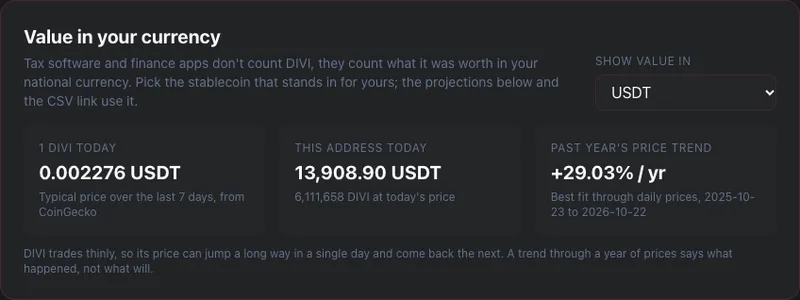
- Show value in offers USDT, USDC, DAI, PYUSD, FDUSD, EURS and USD. The first five are stablecoins that track the US dollar, EURS tracks the euro, and USD is the dollar itself. There is no pound, franc or yen; for those take the dollar figure and convert it with your bank's or central bank's rate.
- 1 DIVI today is a typical price over the last seven days, which smooths out single trades on a thin market.
- This address today is the address's whole balance at that price. The projections further down the tab use the same price and the Plan ahead box lets you set your own.
The picker is remembered in your browser, so every address you open afterwards shows the same currency. Staking returns walks through the rest of the tab.
4For a whole year: the CSV with prices
Every address has a CSV export, a plain spreadsheet file with one row per transaction. Add ?vs= and a currency to the link and two columns appear at the end: the price of one DIVI on that row's day and the row's amount at that price.
https://services.divi.domains/api/rpc/csv/DHfobp6GtP7gTfLPPpPt5wQejsXurmAgtL.csv?vs=eurs
The first two rows of that file at 15:48 UTC on 2026-10-22, both STAKE rows, with the transaction columns left out here for space:
| Date | DIVI | Price (EURS) | Value (EURS) |
|---|---|---|---|
| 2026-10-22 10:50 | 415.00 | 0.00191835 | 0.79611592 |
| 2026-10-21 23:37 | 415.00 | 0.00192822 | 0.80020951 |
The same seven names work here as in the explorer's picker: usdt, usdc, dai, pyusd, fdusd, eurs and usd. The link opens in any spreadsheet and in Google Sheets' IMPORTDATA; Staking returns has the template that sums it by month. Prices go back one year from today, and a day with no price carries the last known one for up to two weeks. Rows older than a year have blank price columns, and so do the few days where the price source has a longer gap: 18 June to 1 July and 17 July 2026.
5Check the source before you trust a column
A price column is only as good as its source, and until 2026-10-22 this site's source was wrong. That morning the CSV priced 2026-10-21 at 0.00066 EURS and 0.00075 USDT, while CoinGecko's price for the same day was €0.00194 and $0.00218, about three times higher.
Both the CSV columns and the explorer box used to take their daily prices from CoinPaprika's page named "Divi (DIVI)", which follows an unrelated Ethereum token with the same name, not the coin. For most of the past year the two moved roughly together, within tens of percent, so the columns looked right. From about 2026-10-16 the token fell away from the coin, and on 2026-10-22 the token stood at $0.00037 while the coin traded at $0.00218. Since 15:45 UTC that day both take the coin's prices from CoinGecko: the rows above price 2026-10-21 at 0.00193 EURS and 0.00218 USDT, within 1% of CoinGecko's €0.00194 and $0.00218 (EURS trades close to the euro, not exactly at it). If you downloaded a priced CSV before then, download it again. DIVI price and market cap explains the two DIVIs.
The check takes a minute:
- Pick three dates from your CSV, spread across the year.
- Look each one up on CoinGecko's or CoinMarketCap's historical data tab in the matching currency (USD for the dollar stablecoins, EUR for EURS).
- If the CSV's price is within a few percent on all three, the column is usable for that period. If it is off by a lot, as it was before the fix in October 2026, take the tracker's prices instead: download the plain CSV (without
?vs=), paste the tracker's daily prices into a column beside it, and multiply.
6A price for the tax file
Most tax offices treat a staking reward as income on the day you receive it, valued in your currency at that day's price, and the later sale as a separate gain or loss against that value. The rules differ by country and change; Staking taxes covers the shape of them and this page only covers the price. What a tax office wants from the price is:
- One consistent source. Pick CoinGecko or CoinMarketCap and use it for every row of the year. Write the source's name in the file.
- A daily figure, not the minute. The day's close or average is accepted everywhere; nobody expects a reward at 23:37 to be priced at 23:37.
- Your currency, from a published rate. If the tracker lacks your currency or you took a dollar stablecoin column, convert with your central bank's daily rate and keep a note of it.
- Keep the evidence. Save the CSV and a copy of the price table you used. A year later the tracker's page may have changed and the explorer's source may have been fixed, and the figures you filed must still be explainable.
A stake reward is worth about a dollar at 2026 prices, and a well-funded wallet earns several a day. The amounts look too small to matter, but a year of them is hundreds of rows and the total is not small. Let the spreadsheet add it up; do not round rows away.
What to do next
- Staking returns: the spreadsheet template that turns the CSV into monthly totals.
- Export address history: every export the explorer offers and what each column means.
- Staking taxes: what the income and gains rules look like for stakers.
- DIVI price and market cap: where the price itself comes from.